 By
ByThe two solo exhibitions, Wound by Alisa Chunchue and Interloper by Mar Kristoff, feel like two sides of the same coin, each offering a distinct yet complementary exploration of human experience. Alisa Chunchue chooses to nurture and mend, transforming trauma into a meditative practice. Mar Kristoff, on the other hand, opts to intervene and question, unraveling memories as fluid, ever-shifting fictions.
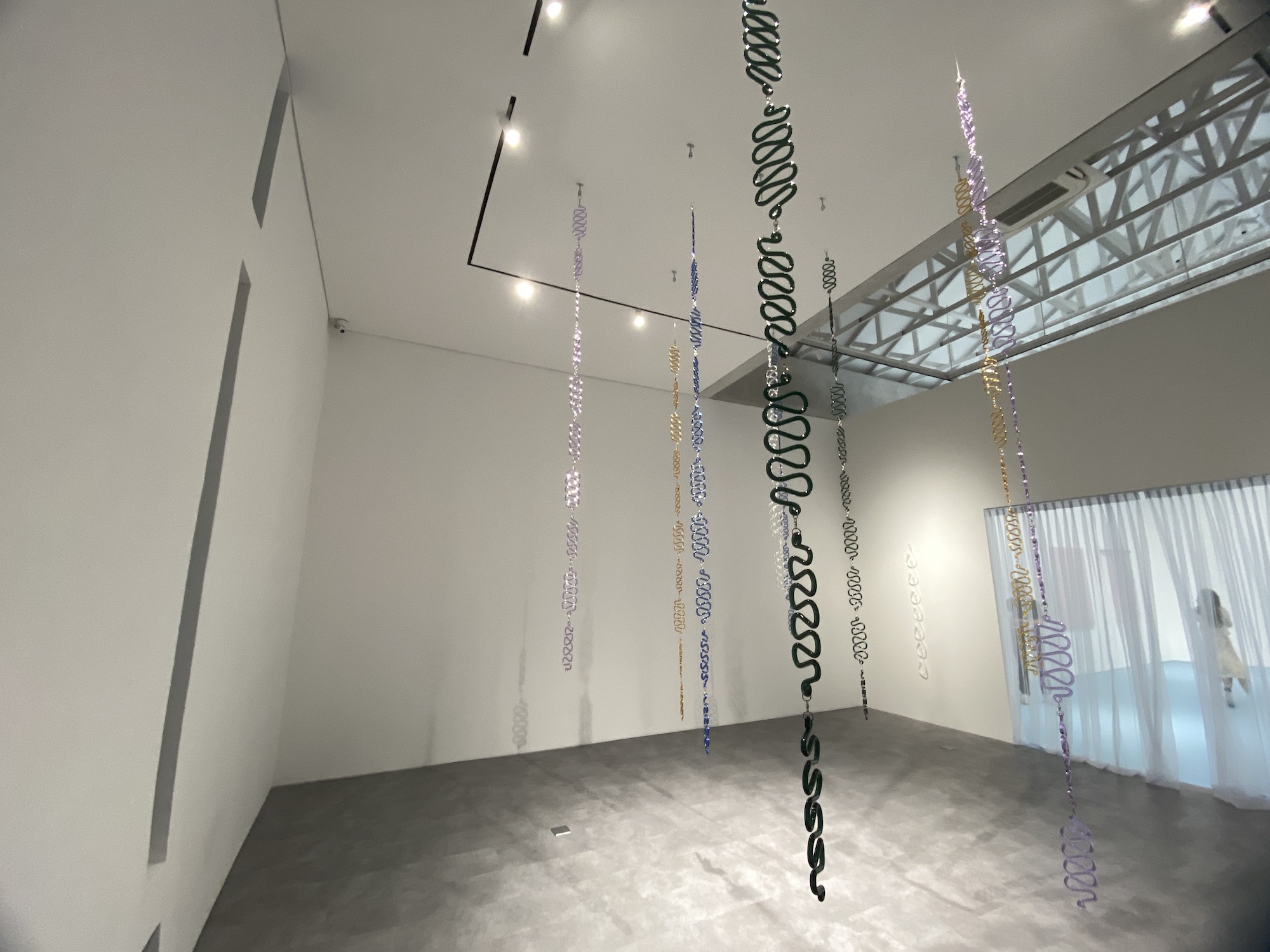
As the opening work of Alisa Chunchue’s solo exhibition Wound, the installation Invisible Suture (2022–2024) greets visitors like a tangible metaphor suspended in space. This piece embodies the invisible stitches that bind unseen wounds, immediately inviting viewers to ponder the exhibition’s thematic direction. From the ceiling of Ara Contemporary’s gallery, delicate yet resilient glass spirals cascade in an array of colors—deep green, soft blue, golden yellow, and metallic silver—forming endless, curving patterns that seem to float weightlessly. Under the gallery’s lighting, each meticulously crafted strand, resembling surgical thread, reflects light and casts subtle shadows on the floor. The surrounding empty white space amplifies the meditative atmosphere and evokes a sense of fragility.
At its core, Invisible Suture visualizes the emotional and physical healing process Alisa has navigated since 2020. The work speaks to how the precision of stitching a physical wound can transform into a meditative act—a practice that is both calming and challenging, uniting the strength of materials with the vulnerability of the human spirit. This sense of “surgery” becomes even more palpable as visitors move deeper into the exhibition. Adjacent to the entrance of the main gallery, the installation Stitching appears like oversized medical tools, featuring needle-like figures poised to perform their task. This piece reinforces the metaphor of healing as a process that is not only delicate but also demands precision and courage.
The transition between Invisible Suture and Stitching and the works in the main gallery is thoughtfully framed by a simple white curtain. More than a physical divider, this curtain is a curatorial masterstroke, creating a threshold akin to a hospital operating room. It heightens anticipation and evokes a sense of sterility, psychologically preparing visitors to delve into a more intimate and profound exploration. Through this spatial narrative, Alisa does more than display objects; she constructs a journey that guides viewers through metaphorical stages—from the suspended threads of Invisible Suture to the tools of Stitching, and finally into the “operating room” where the wounds themselves are laid bare in their most explicit form.
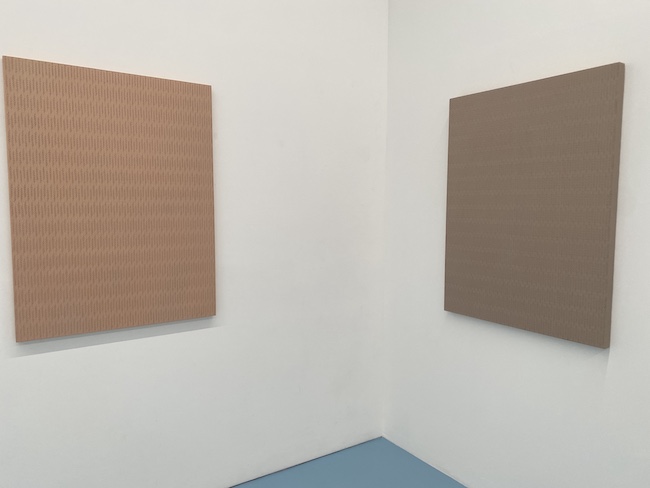
It becomes clear that Alisa is not merely addressing wounds but dissecting the significance of stitches on the human body post-surgery. Stitches are not just a means to close a wound; they are evidence of a battle, a trace of suffering, and, most importantly, a symbol of ongoing healing. Beyond the curtain, visitors encounter a series of deeply intimate and meditative works. Here, Alisa fully reveals her process of emotional and physical recovery. This series explores surgical stitching techniques through pencil on paper and canvas, creating hypnotic, endless circular patterns that fill the space.
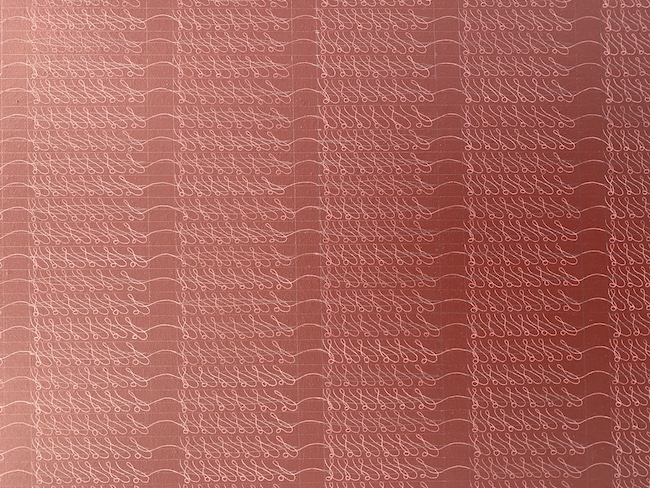
Each “stitch” is handcrafted with extraordinary patience, embodying the essence of Alisa’s artistic practice: a discipline of precision and perseverance where every imagined stitch on paper is both a calming repetition and a reminder of the complexity and tension of mending what has been torn apart.
Intriguingly, from a distance, these works appear as fields of solid color, their organic palette evoking the hues of the human body—blood red, pale skin tones, and the bluish-gray of veins. This effect draws viewers closer, compelling them to imbue these “empty” fields with meaning. Up close, the magic unfolds: repetitive patterns mimicking surgical stitches emerge with striking clarity. At first glance, their near-perfect consistency might suggest mechanical reproduction, but a closer look reveals the trembling pencil strokes, varying pressures, and carefully connected starting and ending points. Each “stitch” is handcrafted with extraordinary patience, embodying the essence of Alisa’s artistic practice: a discipline of precision and perseverance where every imagined stitch on paper is both a calming repetition and a reminder of the complexity and tension of mending what has been torn apart.
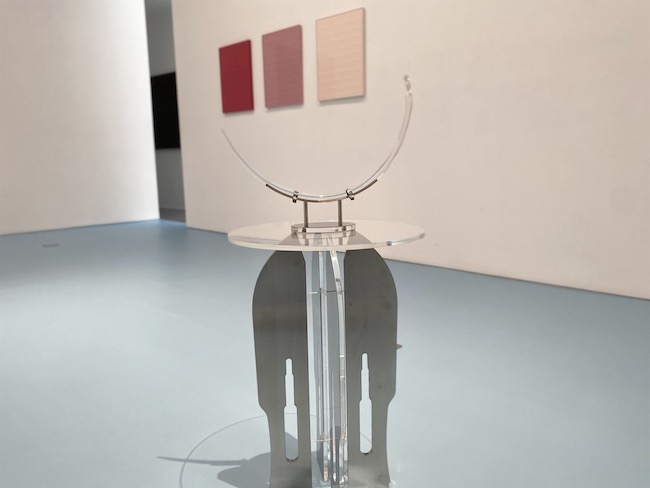
In her installation Invisible Incision (2025), Alisa reimagines the medical instruments that once marked her life—a needle and a scalpel—crafted from glass and stainless steel. These are not mere objects but crystallizations of her bodily experiences. Both literal and metaphorical, Invisible Incision represents the “unseen cuts” that leave no visible scars yet remain etched in memory. The fusion of scalpel and needle in the work conveys a complete cycle: the same tool that cuts also stitches and heals.
Through her series, Alisa shifts the focus from the fearfulness of illness and surgery to a narrative of resilience and contemplation. She does not dwell on trauma but transforms it. Every repetitive pencil stroke on canvas and every precise curve of glass in her installations serves as physical evidence of her endurance through difficult times. Alisa Chunchue, a Thai artist known for exploring the human physical and mental condition through diverse media, roots her artistic process in a deep observation of the body. Her participation in prestigious exhibitions such as ARTJOG: Prophecy (Yogyakarta, 2024), The Sovereign Asian Art Prize Finalists Exhibition (Hong Kong, 2023), and Illuminated Curiosities (Vietnam, 2022) has solidified her position as a unique voice in contemporary art, addressing themes of the body, memory, and healing.
Through Wound, Alisa does not merely present art; she shares a transformative journey where pain is crafted into beauty and fear is overcome through perseverance. Her works are intimate autobiographical fragments, each reflecting the patient breath of persistence in their unbroken patterns and the exhale of relief in their perfected forms.
Blurring to Remember
Alongside Alisa Chunchue’s Wound, Ara Contemporary presents Mar Kristoff’s solo exhibition Interloper. While Alisa dissects the memory of the body, Kristoff explores family archives as an “interloper”—a wanderer navigating the ambiguous spaces of memory, both participant and outsider. In one work, Kristoff recreates a photograph of someone driving a car from the perspective of a backseat passenger. The black-and-white portrait, devoid of a clear face, evokes a sense of alienation and detachment. In another, he revives images of his late father—from elementary school graduations to prom nights—not to indulge in nostalgia but to question the meanings these images carry.
The black-and-white portrait, devoid of a clear face, evokes a sense of alienation and detachment. In another, he revives images of his late father—from elementary school graduations to prom nights—not to indulge in nostalgia but to question the meanings these images carry.
Through blurred brushstrokes, unexpected reframing, and subject displacement, Kristoff challenges the inherited significance of these archives. In his hands, an archive is not a neutral or fixed repository but a fluid site, vulnerable to revision, erasure, and speculation. The exhibition explores the fundamental paradox of memory: the human desire to preserve, juxtaposed against the inevitable distortions of time. Each work is an attempt to hold time still, yet it simultaneously acknowledges that once a memory circulates in the mind, it drifts, absorbing new contexts and subtly betraying its origins.
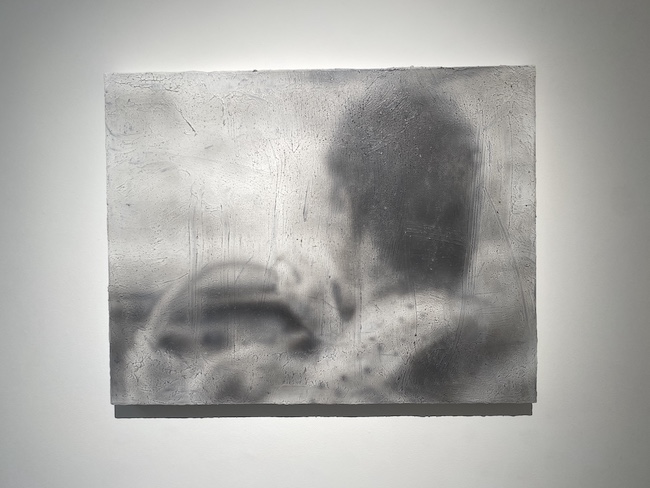
As the 2024 UOB Painting of the Year gold winner, Kristoff does not seek to resolve this tension but amplifies it. The result is a portrait of memory not as a static document but as a dynamic, fragmented, contradictory, and ever-evolving process. Interloper serves as a reminder that, to some extent, we are all outsiders attempting to make sense of inherently fluid and personal narratives of the past.
Together, Wound and Interloper form a profound inquiry into how humans record and make sense of their experiences. Alisa Chunchue chooses to nurture and stitch, transforming trauma into meditation. Mar Kristoff opts to intervene and question, revealing memories as fluid fictions. Through this dual presentation, Ara Contemporary offers a sharp lens to examine how art serves as both a tool for healing and a means to challenge our most personal archives.
- Stitching Wounds, Tracing Memories - October 17, 2025
- Dancing on the Grave of Severed Memories - September 30, 2025
- The Magic of Objects in Stillness - September 30, 2025